
Machine translation awaiting review.
The fiscal code in Italy is a code used to unambiguously identify natural persons and other entities other than natural persons in their dealings with the bodies and public administrations of the Italian State. For natural persons, it generally consists of 16 alphanumeric characters, while for entities other than natural persons, it consists of 11 digits.
The fiscal code is assigned at birth or upon the establishment of associations and organizations. For entities registered with the Registro Mercantil, since 6/12/2000 the fiscal code coincides with the registration number in the Registro (the first 7 digits correspond to the "sequential number", followed by 3 digits identifying the Office and 1 check digit). For all taxable persons other than natural persons with a VAT number (trusts, permanent establishments, companies and, among these, companies with a corporate form, non-commercial companies such as professional partnerships, associations with a VAT number, foundations), it also normally serves as the fiscal code.
History of how the Italian fiscal code came about
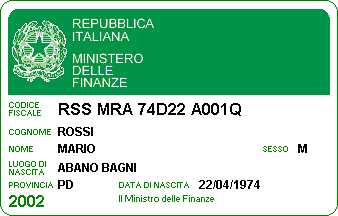
The tax code was introduced by Presidential Decree No. 605 of 29 September 1973 to make financial administration more efficient with the creation of the Anagrafe tributaria (Tax Register Office), strongly desired by the then Minister of Finance Bruno Visentini. It is attributed and issued to every Italian citizen by the Agenzia delle Entrate and can also be attributed to foreign citizens. Since the reform, each person receives a card, first made of paper and then of plastic with a magnetic strip, showing, in addition to the fiscal code, surname, name, sex, place of birth, province of birth, date of birth and year of issue.
How the codice fiscale italiano works
The fiscal code is used by all public administrations in Italy and serves to identify the citizen, the taxpayer and all other entities required to have one.
The codice fiscale card
All persons who meet the requirements and apply for the fiscal code receive a magnetic card with the fiscal code and a unique barcode or, for residents in Italy who also benefit from healthcare assistance, a smart card that serves as:

2. Health card, which has become a means of controlling regional healthcare spending and is intended to contain the health data of citizens living in Italy
3. Health card valid within the European Union.
4. National Services Card with a signature function for access.
The plastic-coated fiscal card has been definitively replaced and integrated into the health card for those entitled to it; for others, the old card still exists.
The paper fiscal identification certificate (green card), which originated in Italy in the early 1970s, remained in its traditional format until the spread of the plastic card.
Separate management by INPS
In the gestione separata (a public social security scheme, mandatory for certain categories of workers), the INPS uses the fiscal code as an assignment number, rather than an assigned numeric code (as is done in other social security schemes, including INPS's own). Registration with the INPS gestione separata 2018 can be carried out at the Chambers of Commerce through the Registro delle Imprese and the "UNICA" communication procedure.
Generation of the tax code
The legislation governing how the fiscal code is calculated is the Decree of the Ministry of Finance of 23 December 1976, ("Coding systems for persons required to register with the tax register").
For natural persons, the fiscal code consists of sixteen alphanumeric characters; for legal persons, such as companies or organizations, it is an eleven-digit number (the first digit is 8 for recognized associations, 9 for unrecognized ones).
For all municipalities in Italy there is an identification card containing the municipality's cadastral code, which is used in the fiscal code. For companies that lack it, the VAT number replaces the fiscal code.
No one is authorized to calculate or provide tools for calculating the fiscal code: the only valid fiscal code is the one issued to the person by the Agenzia delle Entrate.
The algorithm shown below is commonly used to calculate the fiscal code, although it does not guarantee the reliability of the result.
The fiscal code of natural persons consists of sixteen alphanumeric characters, generally derived according to the algorithm indicated below.
Problems with the tax code.
Homocodia.
The mechanism for calculating the fiscal code can result in the generation of identical codes for different natural persons. This is referred to as homocodia of the fiscal code. The Agenzia delle Entrate assigns each person a new code to ensure its uniqueness.
The mechanism by which homocodes are handled allows the fiscal code to be generated by replacing one or more digits (starting from the last) with a letter.
Using all possible combinations of letter-number substitutions, a maximum of 128 different codes can be managed. Cases of so-called homocoded subjects, initially very limited with regard to Italian citizens, have increased considerably over time, especially in the case of foreigners, with a particularly high concentration in the case of those born in countries where it is common practice not to remember the exact day of birth.
Date of birth
The fact that only the last two digits of the year of birth are given means that, all other things being equal, people born a century apart have the same code. For example, a man born on 1 February 1907 has the same code as another born in the same city on the same day in 2007: 07B01.
Place of birth
The fiscal code takes a snapshot of the geopolitical and administrative situation at the time of the natural person's birth; for this reason, it must indicate the actual place (if in Italy) or country (if born abroad) of birth of the person, and not any that may have changed since.
For example, if a person was born in Kiev in 1985, the string formed by the characters between the eleventh and fifteenth would be Z135 (Soviet Union) and not Z138 (Ukraine, which became independent in 1991).
The same consideration applies to the municipality of birth: a person born in a municipality that has since been suppressed or merged (for example, Borgo Panigale, an autonomous municipality until 1937 and part of the municipality of Bologna from that date) will have the cadastral code of the place of birth corresponding to the administrative situation at the time (B027 before 1937, A944, the code for Bologna, afterwards). Obviously, the same applies to cases of municipal territories that have since become autonomous municipalities: for example, those born before 1992 in Fiumicino (then part of the municipality of Rome) will have in their fiscal code the cadastral code H501 of the Italian capital, while the code of those born after that date will include M297, the cadastral code of the new municipality.
Exceptions were some citizens who in the 1970s, although born on Italian territory, had a foreign cadastral code assigned to them because the municipality had become foreign territory after the Second World War.
Check character
The algorithm for calculating check characters is not able to recognize certain frequent types of typographical errors, such as the swapping of two or more letters in even or odd positions.
Change of name
Taxpayers who change their surname or name during their lifetime are also required to update their fiscal code. The problem, initially occasional, is becoming increasingly frequent with the growing number of foreigners, who may change their surnames according to the laws of their country of origin. For example:
● In many countries around the world, foreign women take their husband's surname when they marry and may lose it upon divorce.
Possible contamination of databases.
In cases where information associated with an invalid or false fiscal code (due to fraud, negligence or material error) is present in both private and public databases, such databases become contaminated. Among the most frequent cases are homocodes and unreported changes of name (which entail updating the fiscal code). Much less frequent, but no less possible, is the case where the data is very old and was entered into the database without a fiscal code, with the code being derived in a non-validated manner from the master data using algorithms that have in any case been found.
Self-generation of the tax code
Although there are algorithms capable of independently calculating one's own or another's fiscal code, the only entity authorized by law to issue validated codes with legal effect is the tax register of the Agenzia delle Entrate. Therefore, in the event of a discrepancy between two codes, even if the non-validated one appears to comply with the algorithm, the valid one is the one issued by the tax administration, to the exclusion of any other.
Telematic verification
Since the fiscal code identifies a subject in relations with the public administration, the Agenzia delle Entrate offers a service for verifying the fiscal code (existence in the Anagrafe Tributaria) and/or matching the fiscal code with a subject's personal data [11]. "Mass" use of this service would be desirable in order to "clean up" office databases of incorrect or outdated fiscal codes. The "mass" service is almost exclusively limited to public administrations, public companies and public service managers. The service should not be confused with programs, also found on the Internet, that merely check the fiscal code "only" by comparing it with master data entered by the user, and/or based solely on the check character.
Agenzia delle Entrate verification of the tax code.
There are three online services, completely free and accessible to anyone, that the Agenzia delle Entrate makes available to verify a fiscal code. We describe them below. To access them, it is not even necessary to be registered. The Agenzia delle Entrate portal is as follows:
AGENZIA DELLE ENTRATE - FISCAL CODE VERIFICATION
By accessing this link you have the opportunity to check:
● Whether a fiscal code actually exists;
● Whether the fiscal code actually corresponds to the personal data of a natural person;
● Finally, whether the fiscal code actually corresponds to the name of a company or corporation.
Therefore, the Agenzia delle Entrate service does not allow you to locate the holder of the fiscal code, i.e. to find out their name, surname, date and place of birth, but only allows you to find out whether the fiscal code is actually registered in the Anagrafe tributaria. This way you can find out if you have the wrong fiscal code or if you have been given a code that does not exist.
Personal data found in the codice fiscale italiano
In short, the fiscal code of a natural person reveals personal data, date and municipality of birth, none of which is, however, sensitive.