
Machine translation awaiting review.
Legalization of certified translations through the Hague Apostille
Legalizing a Certified Translation internationally usually requires obtaining the "Hague Apostille", an official stamp placed on the original document, in the country where it was issued, before its certified translation. The Hague Apostille certifies the authenticity of an original document, thus guaranteeing the legal effectiveness of a Certified Translation in any other country that is a signatory to the Hague Convention.
The Hague Apostille is an official stamp that allows a document to be legalized quickly, before its Certified Translation, to guarantee its validity in another country. Find out here what the Apostille is, when you need to affix it, and how and where to request an Apostille for a Birth Certificate, Marriage Certificate or Criminal Record in Madrid, Barcelona, etc.
WHAT IS THE HAGUE APOSTILLE
The Hague Apostille is a stamp that certifies the authenticity of an official document and legalizes it so that it can produce legal effects internationally.
The Hague Apostille is an abbreviated legalization procedure, agreed among the 125 countries that signed the 1961 Hague Convention, to replace diplomatic or consular legalization (which is much slower and more complex). The Apostille only certifies the authenticity of the signature and the seal on the document, not its content. All countries that have signed the Hague Convention undertake to accept the validity of an official document legalized by means of a Hague Apostille.
DO I NEED TO APOSTILLE MY CERTIFIED TRANSLATION?
Your Certified Translation does not need an apostille; what is apostilled is the original document, provided it is a public document, in order to legalize it and certify its authenticity.
It is a very common misunderstanding to think that a Certified Translation must be apostilled, but this is not the case. Certified translations are legal translations, with legal validity, since they are signed and sealed by an official translator accredited by the authorities of their country.
WHICH DOCUMENTS NEED A HAGUE APOSTILLE?
Most official documents must be legalized by means of a Hague Apostille to certify that they are authentic, always before requesting the Certified Translation. In theory, European legislation exempts public certificates from EU member countries from apostille, but in practice it is always better to apostille your documents. Check with the authority to which you are going to submit the document whether you need to legalize your documents. What they tell you is what counts.
- - Civil documents: Birth and marriage certificates, criminal records, etc.
- - Judicial documents: Court judgments, powers of attorney, etc.
- - Educational documents: University degrees, academic transcripts, records, etc.
- - Corporate documents: Deeds of incorporation, patents, annual accounts, etc.
- - Notarial documents: Public deeds, wills, powers of attorney, etc.
IMPORTANT. The Apostille must be added before carrying out the Certified Translation, since it must also be translated by the Sworn Translator.
REQUIREMENTS FOR THE VALIDITY OF THE APOSTILLE
In order to legalize a document by means of a Hague Apostille, both the country of issue of the document and the destination country where it will be presented must have signed the Hague Convention. If one of the two countries is not a signatory to the Hague Convention, you will not be able to legalize by apostille: you will need to go to the embassy or consulate of your country.
COUNTRIES THAT ACCEPT THE HAGUE APOSTILLE
So far a total of 125 countries have signed the Hague Convention and therefore recognize the Hague Apostille (updated February 2024).
The main countries that accept the Hague Apostille are: Germany, Saudi Arabia, Australia, Austria, Belgium, Belarus, Bosnia, Brazil, Bulgaria, Cyprus, Canada, China, Colombia, Korea, Croatia, Denmark, Egypt, Slovakia, Slovenia, Spain, United States, Ecuador, Estonia, Finland, France, Greece, Hungary, Ireland, Iceland, Israel, Italy, Japan, Latvia, Lithuania, Luxembourg, Malta, Morocco, Mexico, Nigeria, Norway, New Zealand, Netherlands, Poland, Portugal, United Kingdom, Czech Republic, Romania, Russia, Serbia, Sweden, South Africa, Switzerland, Tunisia, Turkey, Ukraine, Uruguay, Venezuela (see complete list).
Countries that have not signed the Hague Convention include Egypt, Angola, Nigeria or Thailand (among others).
WHAT THE HAGUE APOSTILLE LOOKS LIKE
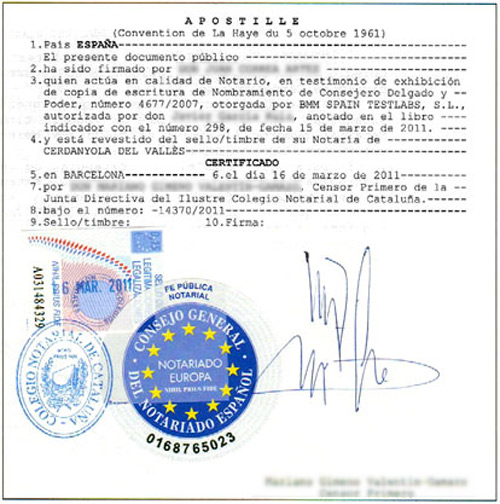
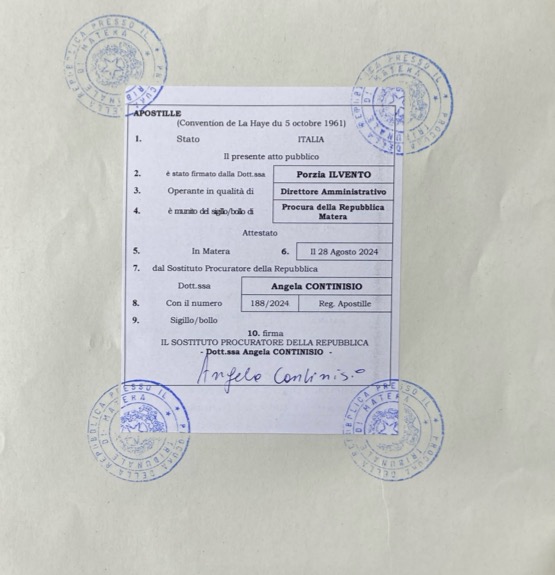
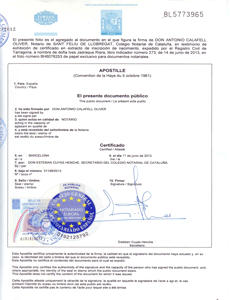
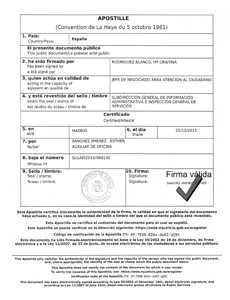
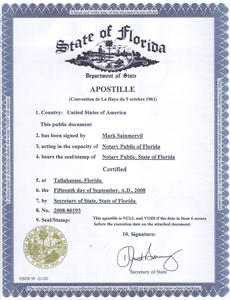
The Hague Apostille is in the shape of a square stamp (sometimes it is a sticker or a sheet) and is placed at the end or on the back of the original document. The Apostille, generally bilingual, summarizes the fundamental data of the original document: (1) country of issue, (2) name of the person signing, (3) title or capacity in which they sign, (4) institution on whose behalf they sign, (5) place where the Apostille is affixed, (6) date, (7) name and title, (8) registration number, (9) seal, and (10) signature of the person affixing the Apostille.
HOW TO AFFIX THE HAGUE APOSTILLE
Affixing the Hague Apostille is a simple procedure, since it only involves verifying the author, date and signature of the original document; the content of the document is not verified. The official or notary places the stamp on the last page, fills in the 10 fields of the Apostille, signs and seals it, and that's it. The complicated part is knowing where to go to request a Hague Apostille.
WHERE TO OBTAIN THE HAGUE APOSTILLE
The Hague Apostille is always affixed in the country of origin of the document, that is, the country where it was issued, since it is the only one that can legalize it. If you have already left your country, then you must go to your embassy or consulate.
Explaining where to request the Hague Apostille in Spain is not simple, since there is no single centralized body that issues it. Depending on the certificate or document, you must go to the Colegio de Notarios, the Ministerio de Justicia, or the Tribunal Superior de Justicia.
» The Colegio de Notarios is who affixes the Apostille to notarial documents such as deeds and powers of attorney, but they also apostille passports, medical certificates and bank certificates.
» The Ministerio de Justicia affixes the Apostille to degrees, records and academic certificates (which must first be sealed by the Ministerio de Educación -legalization of signature). The Ministerio de Justicia, or its Territorial Delegation, is also the place to request the Apostille for criminal records, certificate of residence, marriage certificate, divorce judgments, income tax returns, etc.
» The Tribunal Superior de Justicia is where the Apostille is requested for judgments (e.g. divorce judgments), birth certificates, marriage certificates, civil status certificates, death certificates, etc.
» 2023 UPDATE. The Spanish Ministry finally allows requesting the Hague Apostille online. The e-Apostille or Electronic Apostille can be requested over the internet for a wide range of public documents, including birth, marriage and death certificates, educational, judicial, administrative and notarial documents, among others.