
Machine translation awaiting review.

Here you will find all the questions you may have about sworn translations.
What is a sworn translation?
A Sworn Translation is a certified translation, signed and stamped by a sworn Italian translator authorized by the Ministerio de Asuntos Exteriores y Cooperación MAEC (Ministry of Foreign Affairs and Cooperation). The translator certifies that the translation is a faithful and exact rendering of the original document. All sworn translations must bear the signature and stamp with the identification number of the Sworn Translator
What is an Official Sworn Translator of Italian?
Sworn Translators or official Italian translators are the only ones authorized to translate, sign and stamp their translations, turning them into Official Sworn Translations valid at an international level. A Sworn Translator acts as a notary of language: their signature and stamp attest that the translation is an exact and faithful copy of the original it accompanies. That is the guarantee of international legal validity. In this way, there is a control over who has carried out the translation and a reliability that the translation has not been tampered with.
In Spain, sworn Italian translators depend on the Ministerio de Asuntos Exteriores (MAEC). Although each country regulates sworn translators differently (in some countries an oath before a notary or before a judge is required).
When is a sworn translation necessary?
Official translations of documents from abroad are therefore necessary when we need to carry out any legal, judicial or labor procedure, or a procedure with the Hacienda (Tax Authority), Seguridad Social (Social Security), Immigration, etc., and we need a sworn translator to sign and stamp the translation of these documents, thereby attesting to their legal validity.
How is a sworn translation carried out?
You just need to send us the document properly scanned or as a good quality photograph.
We must print the document together with the translation, so that it is clear that the translation corresponds to that document. Everything is certified, stamped and signed by the Italian sworn translator authorized by the Ministry, and finally we send it to you in paper format to the address you indicate.
Is it necessary to send the original documents?
It is not necessary, we do not need the original document.
We only need the document properly scanned.
The document will be printed together with the translation, making it clear that the translation corresponds to those documents. The translation must be faithful and exact to the original document. Finally, everything will be certified, stamped and signed by our sworn translator authorized by the Ministerio de Asuntos Exteriores and will be sent in paper format to the address you indicate.
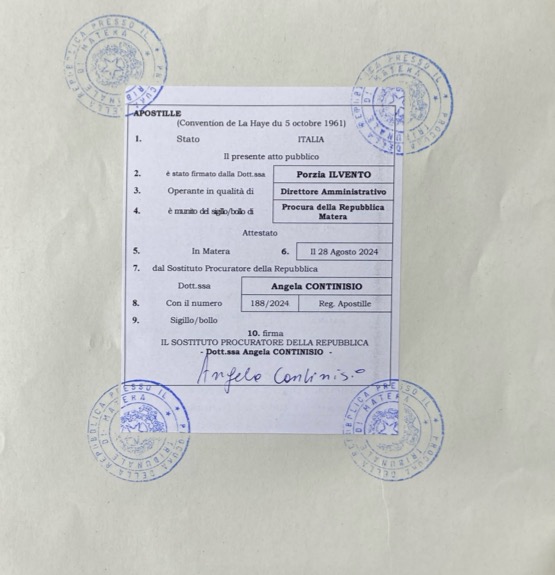
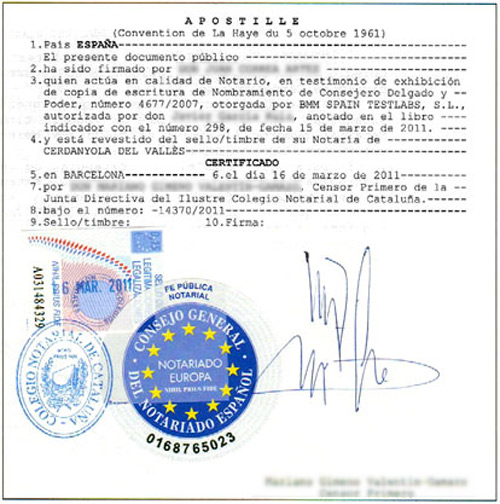
What is the Hague Apostille?
The Hague Apostille is a simplified procedure for the legalization or validation of the signature of a public or notarial document. It involves verifying the authenticity of the document's signature. It is only valid in countries that are signatories to the Hague Convention.
When is the Apostille necessary?
We recommend that you find out where you need to present the documentation. It is there that the procedure is ultimately accepted. In this way, you guarantee correct acceptance and only translate what is necessary.
It is important to carry out the apostille beforehand because it must be included in the translation.
When is legalization of the signature at the Italian consulate in Barcelona or Madrid necessary?
If the sworn translation is to be presented in Italy to the Italian public administration, it must be legalized by the Italian consulate in Barcelona or the Italian consulate in Madrid.
Who can legalize the signature at the Italian Consulate of Barcelona and at the Italian Consulate of Madrid ?
Only sworn translators who have their signature registered with the competent consulate can request the consular legalization of the sworn translation.