Machine translation awaiting review.
History of Italian emigration
Since 1861, some 30 million Italians have sought their fortune abroad. Received with the same prejudices that today we often reserve for immigrants arriving in our country.Immigration-Italians
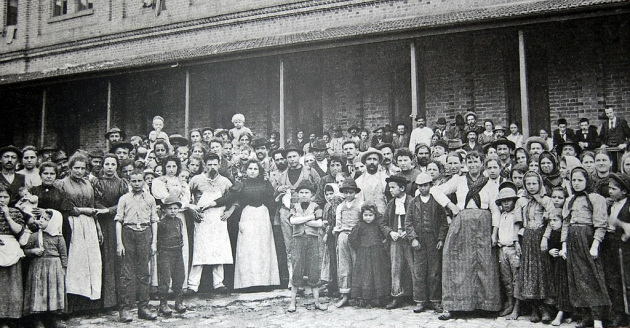
Between 1861 and 1985 almost 30 million emigrants left Italy. As if the entire Italian population of the early twentieth century had left en masse. Most Italian emigrants, more than 14 million, left in the decades following the Unification of Italy, during the so-called "great emigration" (1876-1915).Great emigrations
Entire towns, such as Padula in the province of Salerno, saw their population cut in half during the decade between the 1800s and 1900s. Of these, almost a third had North America, hungry for labor, as their dream destination.They were not just workers starting out. The poorest strata of the population actually had no way to pay for their journey, which is why small landowners prevailed among the emigrants who bought houses or land back home with their remittances.Destinations of emigration
New York and the United States are the most popular destinations. But not the only ones. Just as it was not only the south of Italy that set out. The Genoese, for example, left for Argentina and Uruguay well before 1861.And, like the immigrants who come to us today, the adventure did not begin with the whole family: emigration was almost always planned as temporary and the one who left was generally a single man.The only exception was the great peasant emigration of entire families from Veneto and the South to Brazil, especially after the abolition of slavery in that country (1888) and the announcement of a vast colonization program.Journeys of Hope.
Generally, those who left from the northern regions embarked at Genoa or Le Havre in France. Those who left from the South, however, boarded at Naples. The ratio between first-class and third-class passengers was 5,000 to 17,000, and the differences in treatment for the latter were abysmal: a stuffed straw sack and a chamber pot for every 100 people were the only comforts of a journey that could last up to a month.Many died before seeing the New World. Once they arrived, after passing through the humiliating filter of the Ellis Island immigration office, the challenge of integration began.In South America it was easier to earn a place in the new homeland, but in the United States it was a struggle. Our compatriots preferred to form ghettos in Italian districts and attend parish schools, thus slowing the spread of English within the communities.Prejudices.
In the United States, which had recently abolished slavery, it was said that Italians were not white, "but not clearly black either". In Australia, another destination, they were called "the olive-skinned invasion". And again "an inferior race" or a "lineage of murderers, anarchists and mafiosi". And U.S. President Richard Nixon, recorded in 1973, was the clearest of all. He said: "They are not like us. The difference is in the different smell, the different appearance, the different way of acting. The problem is that you can't find one that is honest".